PAT Testing Services Ireland
Portable Appliance Testing (PAT Testing) helps businesses ensure that electrical equipment is safe to use, properly maintained, and compliant with workplace safety requirements. Safety Squad provides professional PAT testing services across Ireland, helping organisations reduce electrical risks and demonstrate compliance with health and safety obligations.
Is PAT Testing a Legal Requirement in Ireland?
Under the Safety, Health and Welfare at Work Act 2005 and the Safety, Health and Welfare at Work (General Application) Regulations 2007, employers have a legal duty to ensure that work equipment, including electrical appliances, is maintained in a safe condition, inspected at suitable intervals, and supported by appropriate inspection records.
While Irish legislation does not specifically require PAT testing by name, it is widely recognised as the industry-standard method for demonstrating compliance. PAT testing is accepted by the Health and Safety Authority (HSA), insurance providers, and occupational health professionals as evidence that electrical equipment has been properly maintained and inspected.
Failure to inspect and maintain electrical equipment can lead to workplace accidents, insurance complications, HSA enforcement actions, and potential legal liability.
What Does PAT Testing Involve?
Visual Inspection
Every appliance undergoes a detailed visual examination to identify signs of damage, wear and tear, overheating, incorrect wiring, damaged plugs, unsuitable connections, or any other visible defects.
Electrical Testing
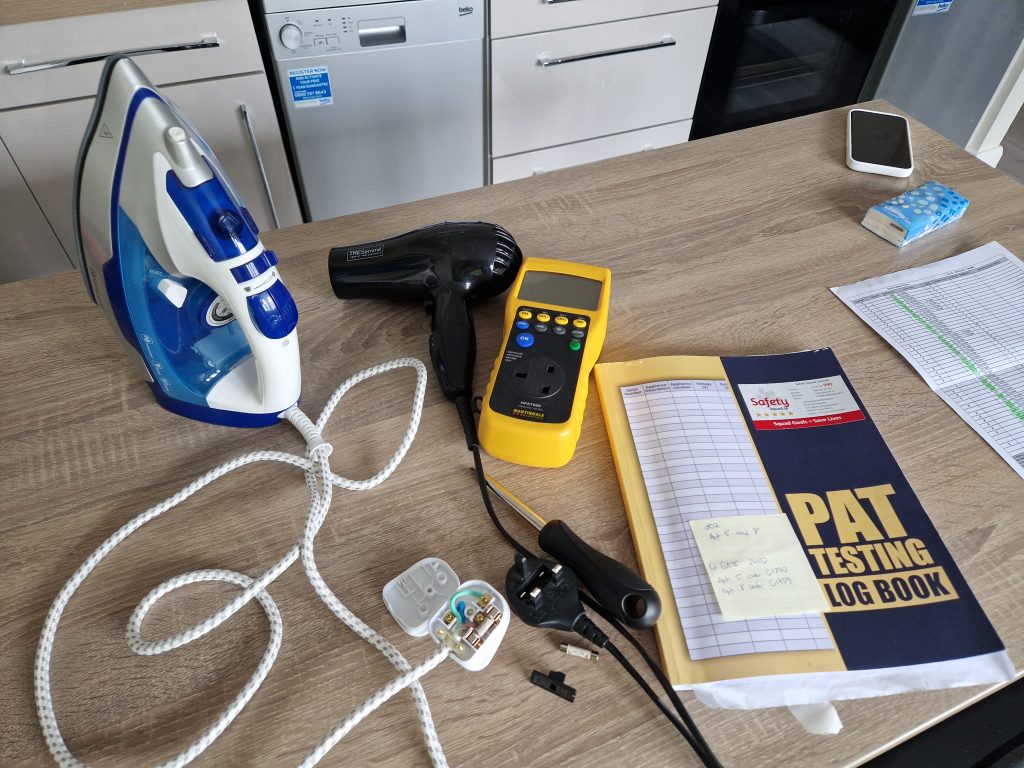
Using calibrated PAT testing equipment, appliances are tested for electrical safety, including earth continuity, insulation resistance, and leakage current where applicable. These tests can identify faults that may not be visible during visual inspection.
Labelling & Documentation
Each appliance is labelled with a pass or fail sticker showing the test date and recommended retest date. A detailed asset register and compliance documentation are provided following testing.
How Often Should PAT Testing Be Carried Out?
Testing frequency depends on the type of equipment and the environment in which it is used. Higher-risk environments generally require more frequent testing.
- Offices & Low-Risk Environments: Every 2–4 years for most Class I equipment
- Retail & Hospitality: Typically every 12 months
- Construction Sites: Every 3 months to 12 months depending on usage
- Industrial Facilities: Based on risk assessment and equipment type
- New Equipment: Visual inspection before first use
Safety Squad will assess your workplace and recommend a testing schedule based on your equipment, environment, and operational risks.
What You Receive After PAT Testing
- Full itemised PAT test register
- Digital and hard copy testing records
- Pass and fail labels applied to equipment
- PAT Testing Certificate for compliance records
- Recommendations for repairs or replacements
- Suggested retest schedule for ongoing compliance
Why Choose Safety Squad?
- Qualified and experienced PAT testing technicians
- Fast, efficient testing with minimal disruption
- Out-of-hours appointments available
- Comprehensive compliance documentation
- Support for offices, retail, hospitality, healthcare, education, and industrial sectors
- Trusted by businesses across Ireland
Industries We Support
- Offices and Corporate Workplaces
- Retail Stores and Shopping Centres
- Hotels, Restaurants and Hospitality Businesses
- Healthcare Facilities and Clinics
- Schools, Colleges and Educational Institutions
- Construction Sites and Contractors
- Warehouses and Logistics Operations
- Manufacturing and Engineering Facilities
Book Your PAT Testing Today
Protect your employees, customers, and business by ensuring your electrical equipment is safe, compliant, and properly maintained.
Call 01 636 3112 to arrange PAT testing for your premises, or complete our enquiry form today.
Frequently Asked Questions
What is PAT Testing?
PAT Testing stands for Portable Appliance Testing. It involves inspecting and testing electrical appliances to ensure they are safe for continued use.
Is PAT Testing mandatory in Ireland?
While Irish legislation does not specifically require PAT testing by name, employers must maintain electrical equipment in a safe condition. PAT testing is the most widely accepted method of demonstrating compliance.
What types of equipment require PAT testing?
Common items include computers, monitors, kettles, microwaves, printers, extension leads, power tools, chargers, kitchen equipment, and other portable electrical appliances.
How long does PAT testing take?
The duration depends on the number of items being tested. Most offices and small businesses can be completed within a few hours.
Will PAT testing disrupt our business operations?
We work efficiently to minimise disruption and can often carry out testing outside normal business hours if required.
What happens if an appliance fails?
Failed items are clearly labelled and recorded. We provide recommendations for repair, replacement, or removal from service.
How often should office equipment be tested?
Most office equipment requires testing every 2–4 years, although testing frequency should always be based on risk assessment and usage.
Do I receive a PAT Testing certificate?
Yes. Following testing, you receive a certificate and detailed equipment register for your compliance records.